


















Within the past few weeks, two words have lived rent-free in the minds of students and personnel of SCUSD: Right-sizing. These words have echoed throughout our hallways, been whispered within the walls of classrooms, reposted on social media pages, and discussed in conversations between students and teachers. It’s a simple two-word phrase, but it does not have a simple meaning.
Generally speaking, right-sizing is a process used to reevaluate an organization’s structure. Industries of business, non-profits, health care and even education use this elimination process to consolidate its resources and increase profitability, often through the reevaluation of its programs and personnel. According to district leadership, the district must right-size as a result of the district’s major budget deficit. In other words, the district’s been spending more money than it’s been making, which is resulting in cuts needing to happen.
In a recent interview, Superintendent Dr. Damon Wright emphasized that right-sizing and mass layoffs are key to long-term sustainability for the district; these decisions, while emotionally challenging, are made to prioritize district preservation. In this case, the district layoffs are “based upon seniority,” meaning that faculty who have been employed by the district the longest are less threatened than newly-hired faculty within the district.
To the district, right-sizing is believed to be a realistic decision.
“[C]ulture and morale really takes a dip,” Wright noted, “[but] there is a business side to this that also has to be addressed.”
Wright’s practical framing, which emphasizes the district’s seemingly proactive rather than a reactive response, is important to those trying to comprehend why right-sizing is happening. While students and faculty are having to balance the emotional weight that right-sizing is causing, the district is managing the practicality.
According to Wright, declining student enrollment is one of the biggest reasons that the budget deficit became a real issue.
“I have 14 years worth of data that shows a decline [in student enrollment] over 14 years,” Mark A. Schiel, the district’s Chief Business Official, remarked during an interview, “… [which means] the student-to- teacher ratio [must be] addressed.”
Objectively speaking, it should be acknowledged that any district that has an excess number of teachers in comparison to the population of students, may be financially unrealistic; if there are too few students for every teacher, resources may be inefficiently allocated or may even go to waste.
That said, this is why it is necessary to question why the district decided to hire more teachers within the past four years once MacDonald was established. Despite the district’s “14 years” of data that highlights the declining student enrollment, the district chose to hire teachers outside of SCUSD as opposed to transferring SCUSD teachers from other schools, such as Santa Clara High School or Wilcox High School.
“Our district decided to maintain staff to provide programming and staffing for…students,” Wright clarified, “and at the same time, our student enrollment declined significantly.”
According to Santa Clara Unified School District financial records, the district has been aware of the very budget crisis it is now trying to mitigate. Public records, dating back to a minimum of four years, reveal that district expenditure has surpassed district revenue, meaning that the district has spent more money than it had. Take, for instance, the district’s second interim update to the budget, which reviewed SCUSD’s total revenue in comparison to expenditures during 2023 to 2024. According to the record, SCUSD was $47,024,625 over budget.
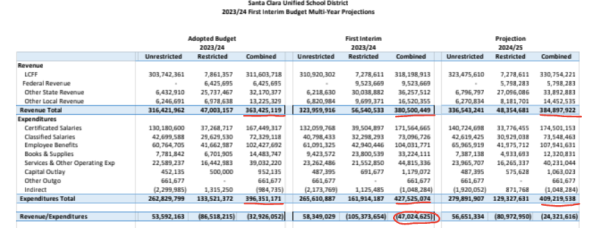
2023/24 First Interim Budget Multi-Year Projections
“It would be speculation for me because I wasn’t [at SCUSD] to make that decision,” outlines Wright.
In the Santa Clara School District Office, the core values of SCUSD are plastered on the walls of the boardroom in which public meetings are held. The first value is titled “Students First,” meaning that the district is supposed to act in the best interest of students. Every morning when students first enter the classroom or leave every afternoon, they are greeted and sent off by the same smiling teachers. Every PCBL, students are met with educators who are willing to tutor students until complex concepts like photosynthesis or the quadratic formula are fully understood. Every class period, rulers, calculators, and various other materials are utilized by students who never have to question how they got there. But, how did they get there?
“Materials like calculators…beads… [were all] purchased through [Anna] Lucas and [me],” Tiffany Cheng, founding head of the Science Department, recalls, “…[and] there’s no reimbursing.”
Cheng and Lucas aren’t the only ones. MacDonald’s teachers not only invest their time, effort, and care in creating what MacDonald is today, they’ve also dedicated their own money voluntarily. Therefore, is it in the best interest of students to lose these teachers—teachers who’ve devoted their careers to ensure students succeed, regardless of the cost?
In the words of Cheng, “We want our students to have the best experience.”
Evidently, students at MacDonald would not be the same without MHS teachers. Wright’s and Schiel’s controlled language regarding faculty layoffs make the right-sizing process feel more logical and less extreme. However, the words of district leadership do not negate the complex situation teachers must face.
“I’ve lost faith in the district,” Cheng reports, “…I came over [with other teachers who] had so many years of experience in other districts.”
Cheng as well as numerous other teachers and faculty have left tenured-positions to contribute to the culture of a new school, yet are now facing backlash from SCUSD.
“We don’t know how much MacDonald’s staff will be impacted,” Wright said, “but we won’t know how many [teachers] could be impacted by this until course requests come in.”
While Wright has assured us that no definite decision has been made regarding the right-sizing effect on teachers in MacDonald in particular, it is true nonetheless that a large proportion of MacDonald teachers are new to the district. Therefore, logically, teachers at MHS would have a higher likelihood of being impacted by this right-sizing process, although it is not confirmed.
It is true that Dr. Damon Wright was recently hired as SCUSD’s new Superintendent in July of 2025, meaning he did not cause the budget deficit problem that right-sizing is attempting to “fix.” Nevertheless, Wright now serves as the Chief Executive Officer of the district board; he is the one who ultimately leads district-wide operations, including right-sizing. Therefore, Wright did not cause the budget issue within the district, but is responsible for the solution. Therefore, we as students within the Santa Clara School District have the right to ask this question: Is right-sizing the best solution?
Right-sizing is undeniably more than a complex tension between a budget ledger and a teacher’s job. It’s a decision that will affect hundreds of faculty, thousands of students, and the district’s financial situation as well as its reputation.
While right-sizing is a painful reality, it is a reality nonetheless. How this all plays out remains to be seen, but as it does, it is indisputable that supporting our teachers and holding our district accountable should never be in question.